 Maths Solver
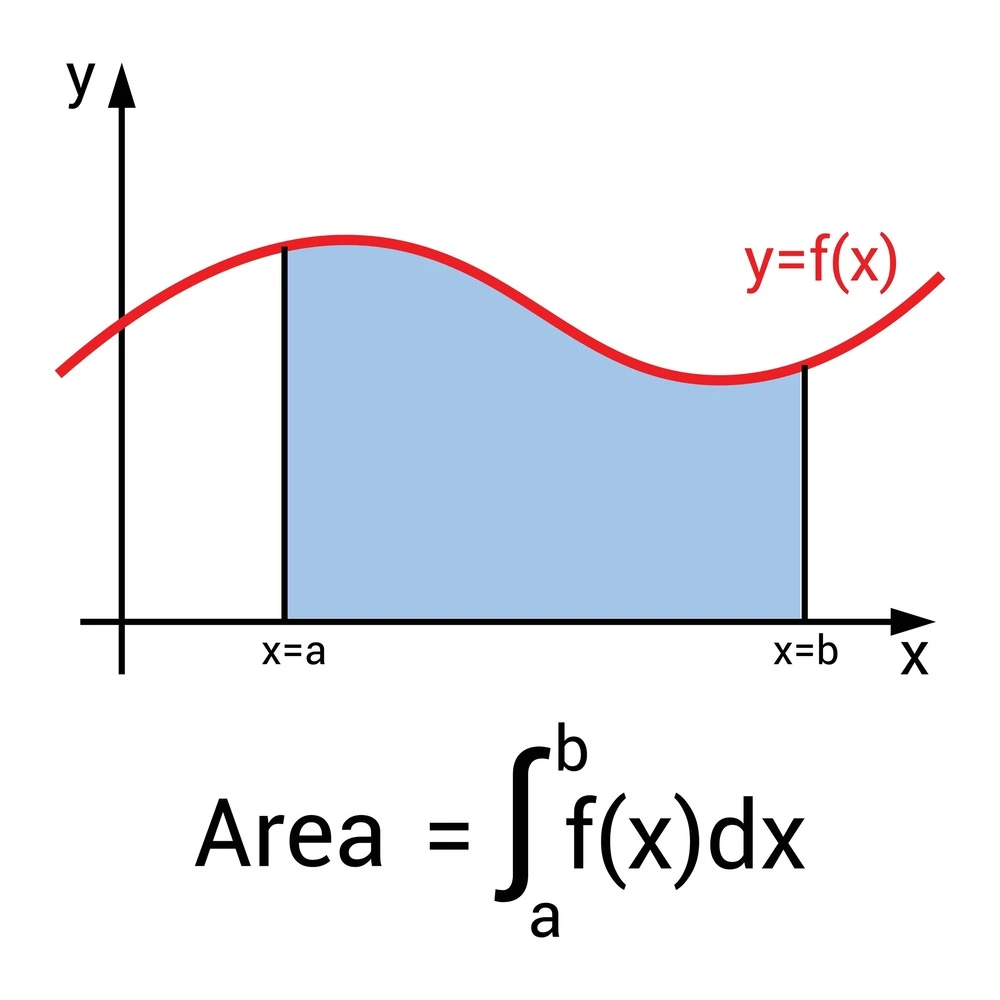
A definite integral is a number that measures the signed area between the graph of a function and the $x$-axis, between two specified $x$ values. Two parts of that sentence matter: it is a single number (not a function, the way an indefinite integral is), and the area is signed — regions below the axis count as negative.
This article walks through where the integral comes from (Riemann sums), the theorem that lets you compute almost all of them analytically (the fundamental theorem of calculus), and what to do when the integral has no elementary antiderivative (use a numerical method, of which the embedded calculator does Simpson’s rule).
The Riemann-sum picture
Take any function $f(x)$ on an interval $[a, b]$. Slice the interval into $n$ equal pieces of width $\Delta x = (b - a)/n$. On each piece, draw a rectangle of width $\Delta x$ and height $f(x_i^*)$ for some sample point $x_i^*$ inside the piece. Add up the areas of all the rectangles. The result — the Riemann sum — is an approximation to the area under the curve:
$$\sum_{i=1}^{n} f(x_i^*)\, \Delta x.$$
As $n \to \infty$ the rectangles get thinner, the staircase approximation gets closer to the curve, and the sum approaches a limit. That limit is the definite integral:
$$\int_a^b f(x)\,dx \;=\; \lim_{n \to \infty} \sum_{i=1}^{n} f(x_i^*)\, \Delta x.$$
The fundamental theorem of calculus
The Riemann-sum definition is conceptually clean but completely impractical for computing integrals by hand. The fundamental theorem of calculus rescues us. It says: if $F$ is any antiderivative of $f$ (meaning $F'(x) = f(x)$), then
$$\int_a^b f(x)\,dx \;=\; F(b) - F(a).$$
The whole machinery of integration reduces to: find an antiderivative, plug in the upper limit, plug in the lower limit, and subtract. A worked example. Compute $\int_0^2 (3x^2 + 2x)\,dx$.
An antiderivative is $F(x) = x^3 + x^2$ (you can check by differentiating it back: $F'(x) = 3x^2 + 2x$). Then
$$\int_0^2 (3x^2 + 2x)\,dx = F(2) - F(0) = (8 + 4) - 0 = 12.$$
The bracket notation
You will often see the intermediate step written with square brackets:
$$\int_0^2 (3x^2 + 2x)\,dx = \left[ x^3 + x^2 \right]_0^2 = (2^3 + 2^2) - (0^3 + 0^2) = 12.$$
This notation is just shorthand for “evaluate at the top, evaluate at the bottom, subtract.” The expression inside the brackets is the antiderivative, and the small numbers at the right tell you the two values to plug in.
Antiderivatives of the standard functions
The integrals you will use most are the reverses of the derivatives listed in the derivative guide:
- $\int x^n\,dx = \dfrac{x^{n+1}}{n+1} + C$ (for $n \ne -1$)
- $\int \dfrac{1}{x}\,dx = \ln|x| + C$
- $\int e^x\,dx = e^x + C$
- $\int \sin x\,dx = -\cos x + C$ (the minus sign is here, not on the cosine integral)
- $\int \cos x\,dx = \sin x + C$
For definite integrals, the constant $C$ cancels in the subtraction $F(b) - F(a)$, so you can just leave it out from the start.
Negative integrals and signed area
$\int_0^{2\pi} \sin x\,dx = [-\cos x]_0^{2\pi} = (-1) - (-1) = 0$. The function is positive on $(0, \pi)$ and negative on $(\pi, 2\pi)$, and the two halves cancel exactly. The integral is zero, but the geometric area “between the curve and the axis, with no sign” is $4$. If a question asks for the area, take the absolute value of the integrand and integrate piecewise across the sign changes; if it asks for the integral, sign matters.
The mistakes I see most often
1. Antidifferentiating $1/x$ as $\ln x$ instead of $\ln|x|$
$\int 1/x\,dx = \ln|x| + C$. Without the absolute value the formula is wrong on the negative reals. For definite integrals where the limits are both positive (or both negative) it makes no practical difference, but get into the habit anyway.
2. Sign error on $\int \sin x\,dx$
The minus sign in the antiderivative trips students up because $\sin\,$’s derivative is $\cos$ (no minus sign). A useful sanity check: differentiate your answer. If you get back to the integrand, including the sign, you have it right.
3. Forgetting to subtract the lower limit
$F(b) - F(a)$, not just $F(b)$. The most common version of this mistake is when the lower limit is zero and $F(0) = 0$, where it happens to give the right answer by accident. Then the same student gets a non-zero lower limit on a test and forgets the subtraction.
4. Trying to integrate something that has no elementary antiderivative
$\int e^{-x^2}\,dx$ has no antiderivative in terms of standard functions. Neither does $\int \sin(x^2)\,dx$ or $\int \tfrac{\sin x}{x}\,dx$. If you are stuck on an integral and your manipulation is not getting you anywhere, the integral may genuinely be one of the elementary-impossible ones — in which case you need a numerical method, like the calculator above, not a clever substitution.
Where this comes up later
Volumes by the disk and shell methods, the average value of a function, the work done by a variable force, probability density functions in statistics, arc length and surface area — all of these are definite integrals in disguise. Once you can compute and interpret $\int_a^b f(x)\,dx$, the rest of the integral applications are mostly a question of writing down the right $f$.
References
- Stewart, J. Calculus: Early Transcendentals, 8th ed., Cengage, ch. 5 (Integrals).
- Wikipedia: Integral, Fundamental theorem of calculus, Simpson’s rule.
- MIT OpenCourseWare 18.01 — Single Variable Calculus, lectures 17–26.