 Maths Solver
AP Calculus is the College Board’s pair of high-school calculus exams. AB covers what is essentially a one-semester university calculus course; BC covers a full year, adding several topics that AB omits. The exam structure is identical for both: a multiple-choice section and a free-response section, each split into a calculator-active half and a no-calculator half.
This page is the practical view: what is on each exam, what BC adds that AB does not have, where the calculator helps and where it does not, and how I would prepare for either one in the months before May.
The difference between AB and BC
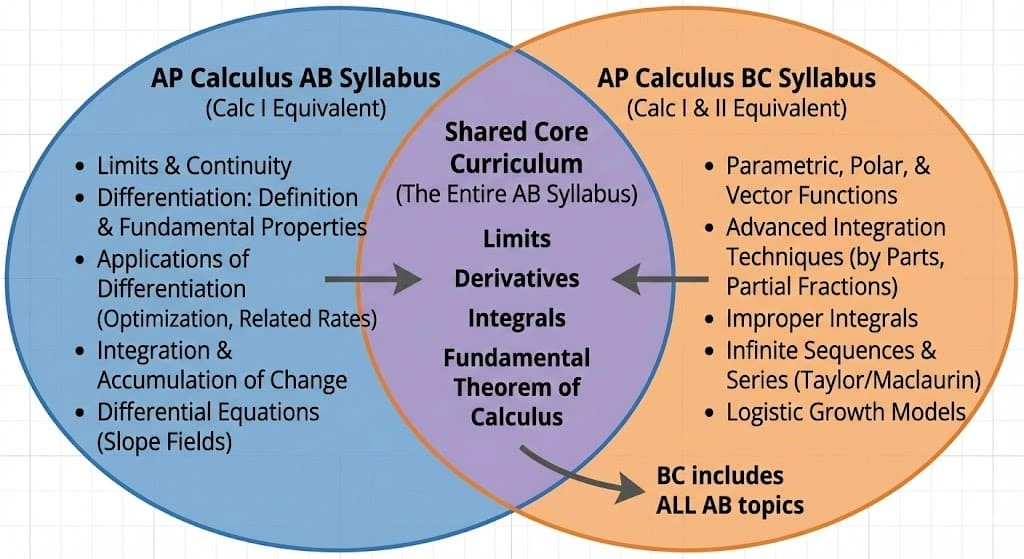
AB is roughly equivalent to Calculus I at a US university: limits, derivatives, applications of derivatives, basic integrals, and the integral applications that fall out of the fundamental theorem.
BC contains everything in AB and adds:
- more advanced integration techniques (integration by parts, partial fractions, improper integrals);
- parametric equations, vector-valued functions, and polar coordinates — including their derivatives, arc lengths, and areas;
- infinite sequences and series, including the convergence tests, Taylor and Maclaurin series, and the Lagrange remainder bound.
The series content is the largest single addition and the topic that makes BC harder to cram for. If you can choose between the two and you are at all unsure, AB is a safer first choice; you can always self-study the BC additions later for college credit if your university grants it.
Exam structure
Both exams are $3$ hours $15$ minutes long, split as follows:
- Section I: $45$ multiple-choice questions, $1$ hour $45$ minutes total.
- Part A: $30$ questions, $60$ minutes, no calculator.
- Part B: $15$ questions, $45$ minutes, calculator allowed.
- Section II: $6$ free-response questions, $1$ hour $30$ minutes total.
- Part A: $2$ questions, $30$ minutes, calculator allowed.
- Part B: $4$ questions, $60$ minutes, no calculator.
Multiple-choice and free-response are weighted equally for the final score, which is reported on the AP $1$–$5$ scale. A $5$ requires roughly $65\%$ of the available marks; a $3$ (the lowest score most universities accept for credit) requires about $40\%$.
What “calculator allowed” really means
The College Board approves graphing calculators (including the TI-84, TI-Nspire, and Casio fx-9750GIII series). On the calculator sections you may use the calculator for four specific tasks: plotting a function, finding zeros, computing a numerical derivative at a point, and computing a definite integral numerically.
Concretely: you do not have to evaluate $\int_0^3 e^{-x^2/2}\,dx$ analytically — you punch it into the calculator. But on free-response questions you still need to write down the integral you are computing; just stating “$0.856$” without showing what you integrated will not get you full marks.
Topics by frequency
The College Board publishes “weighting bands” that describe roughly what proportion of each year’s exam comes from each content area. Numbers are approximate and vary slightly year to year.
For AB:
- Limits and continuity: 10–12%.
- Differentiation (definition and rules): 10–12%.
- Differentiation (composite, implicit, inverse): 9–13%.
- Applications of derivatives (extrema, related rates, optimisation): 10–15%.
- Integration and the fundamental theorem: 17–20%.
- Differential equations (separable, slope fields): 6–12%.
- Applications of integration (area, volume, average value): 10–15%.
For BC, add to the AB topics:
- Parametric, vector, polar: 11–12%.
- Infinite sequences and series: 17–18%.
(The other AB-shared topics get correspondingly squeezed in BC.)
The free-response questions you can predict
Across the past decade or so, the six free-response questions on each exam have followed predictable themes. You will almost always see:
- a question with a function defined by an integral, $f(x) = \int_a^x g(t)\,dt$;
- a related-rates or optimisation problem with a real-world setup;
- a question involving a function given as a table of values, asking for derivative or integral approximations;
- an area-and-volume problem with a region bounded by two curves, asking for area, a volume of revolution, and a cross-section volume;
- a slope field or differential equation problem (especially common on AB);
- on BC: at least one question on Taylor or Maclaurin series, often asking for the radius of convergence and a Lagrange remainder bound.
Knowing this structure in advance means you can practice the standard forms of each question type rather than approaching every free-response problem cold.
How I would prepare
The AP exams favour students who can do the calculations quickly and accurately under time pressure. Most candidates know the theory; the distinguishing factor is execution speed. Practical advice:
First, work through every released free-response question from the last $5$–$10$ years. They are all available free on the College Board website, with rubrics. The patterns repeat heavily.
Second, do the no-calculator multiple-choice section without a calculator from day one. Building speed without the tool you cannot use on Part A is the single highest-return habit.
Third, memorise the small but non-trivial list of derivatives, antiderivatives, and Taylor series of standard functions. The derivative, definite integral, and limit guides on this site cover the techniques; commit the lookup table to memory.
The mistakes I see most often
1. Forgetting the chain rule on implicit differentiation
When you differentiate $y^2$ with respect to $x$, the chain rule gives $2y \cdot y'$, not $2y$. Implicit differentiation problems are designed to catch students who skip the $y'$ factor.
2. Forgetting $+ C$ on indefinite integrals
On a free-response indefinite-integral question, the $+ C$ is worth a mark on its own, and rubric markers do not give you the benefit of the doubt. Always write it.
3. Mis-stating the conclusion of an existence theorem
The mean value theorem, intermediate value theorem, and extreme value theorem all have the same general form: if certain conditions are met, then a certain conclusion follows. Free-response questions reliably test whether you can state the hypotheses precisely. Vague answers lose marks.
4. On BC, failing to check convergence before applying a series
“Use the Maclaurin series of $f$ to approximate $f(2)$” is only valid if $2$ is inside the interval of convergence. Always check.
References and source documents
- College Board — AP Calculus AB course and exam description.
- College Board — AP Calculus BC course and exam description.
- Past free-response questions (free, with scoring guidelines).
- Stewart, J. Calculus: Early Transcendentals, Cengage — the textbook closest to the AP syllabus in coverage and notation.