 Maths Solver
GCSE Maths is sat at the end of Year 11 in England, Wales and Northern Ireland, by almost every student in the country. The current specification, in place since 2017, has the same five content areas across all three exam boards (AQA, Edexcel, OCR), and the same overall structure: three papers, two with a calculator and one without, $80$ marks each.
There are two tiers, foundation and higher. Foundation tops out at a grade $5$ (a strong pass under the new $9$–$1$ grading); higher tops out at $9$ but cannot drop below a $3$. Picking the right tier is a real decision and almost always one your teacher should make with you, because the question styles are different even for topics that are formally on both syllabuses.
The five content areas
The current specification weights the five areas roughly as follows. The percentages differ slightly between foundation and higher.
- Number — arithmetic, fractions, percentages, indices, surds, standard form. ~25% (foundation), ~15% (higher).
- Algebra — equations, inequalities, sequences, graphs, functions. ~20% (foundation), ~30% (higher).
- Ratio, proportion and rates of change — ratios, direct/inverse proportion, similarity, compound measures. ~25% on both tiers.
- Geometry and measures — angles, perimeter/area/volume, transformations, vectors, basic trig. ~15% (foundation), ~20% (higher).
- Probability and statistics — tree diagrams, Venn, averages, charts, conditional probability. ~15% on both tiers.
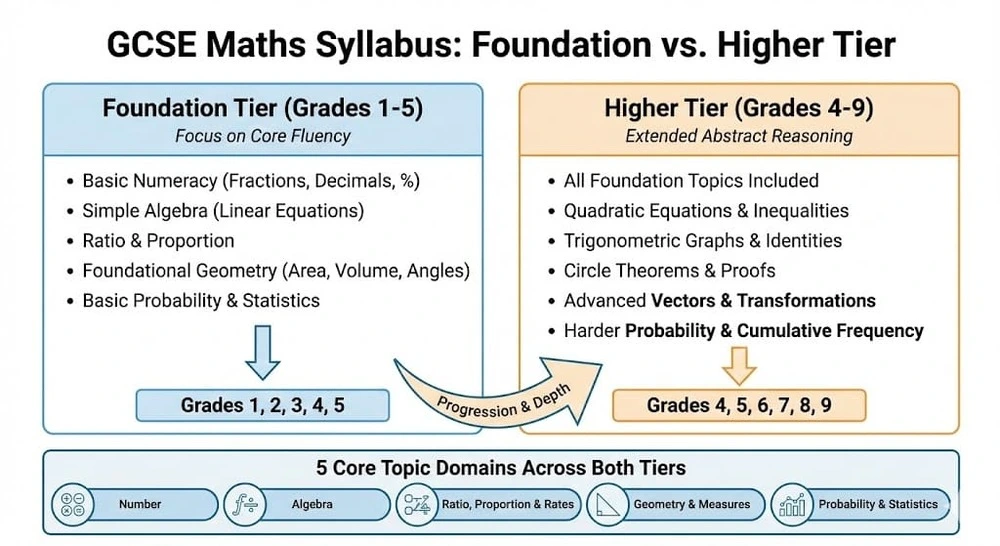
Higher-tier-only content (the part that actually distinguishes the tiers)
Most of the foundation content is also on higher; what is on higher and not foundation is a relatively small list of topics, and they are worth knowing precisely because they are where higher candidates actually drop marks:
- The quadratic formula and completing the square.
- Surds (rationalising denominators, simplifying $\sqrt{a} \pm \sqrt{b}$).
- Algebraic fractions: simplifying, adding, multiplying, dividing.
- Iteration formulas (the “use $x_{n+1} = f(x_n)$ to find a root to 3 dp” question, which appears almost every series).
- The sine and cosine rules, and area $= \tfrac{1}{2} ab \sin C$.
- Vectors as column vectors and proofs about parallel/colinear points.
- Functions: composite, inverse, transformations of graphs.
- Conditional probability and tree diagrams with replacement vs without.
If you are a higher candidate and any of these list items make you flinch, that is where to spend revision time first. Foundation-shared content can be picked up in past-paper practice; the higher-only topics need targeted study.
The three papers
Paper 1 is non-calculator. The maths is no harder than on the other two papers, but the arithmetic is on you, and the questions are calibrated to be fair without a calculator: integer answers, nice fractions, and surds left in surd form rather than evaluated.
Papers 2 and 3 are calculator-allowed and structurally identical. The calculator does not make hard topics easy, but it changes the realistic question style: the numbers are uglier, the percentages are more elaborate, and questions involving compound measures (speed, density, pressure) become much more common.
All three papers are out of $80$ marks, $1$ hour $30$ minutes long, and worth one third of your total. Within each paper the questions get progressively harder; the last few questions on the higher-tier papers are usually the multi-step ones that separate $7$s from $8$s and $9$s.
The formula sheet
From the 2024 series onward, all three boards provide a formula sheet with the standard volume formulas (cone, sphere, frustum), the quadratic formula, the sine and cosine rules, area $= \tfrac{1}{2} ab \sin C$, and the kinematic equations. Topics like Pythagoras, the area of a triangle from base and height, and circle area/circumference are not on the sheet and you have to know them.
An eight-week revision plan
Eight weeks is roughly the gap between mock exams in March and the real papers in May, which is when most students start seriously revising. The plan below assumes about three to four hours of revision per week, increasing in the last fortnight.
Weeks 1–2. Sit two complete past papers (one calc, one non-calc) under timed conditions and mark them. The point is diagnosis, not score. Identify the topics that came up and you either skipped or got wrong.
Weeks 3–5. One topic per evening from your weak-list. Read the relevant article (or your textbook chapter), do $15$–$20$ practice questions on that topic, and check your answers. By the end of week $5$ you should have re-covered every weak topic at least once.
Weeks 6–7. Two papers per week under timed conditions. Do them on Saturdays, mark them on Sundays, and revisit the topics that bit you each time.
Week 8. One light past paper, plenty of sleep, formulas reviewed daily but no new content. The week before the exam is for consolidation, not learning.
The mistakes I see most often
1. Skipping “show that” questions
Higher-tier papers often have a question that gives you the final answer and asks you to derive it. The instinct is to skip and come back, because there are no “easy marks” visible. But the marks are awarded for the working, not the conclusion, and these questions are usually solvable in three or four lines if you start. Always start.
2. Decimal answers when surd or fractional answers are wanted
Non-calculator paper: leave $\pi$, $\sqrt{2}$, and fractions in their exact form. Writing $\pi \approx 3.14$ when the question wants an exact answer loses the mark.
3. Forgetting to give units
“Find the area of the triangle” with sides given in cm expects an answer in cm$^2$. Without the units, partial credit only. This is the most-missed easy mark on geometry questions.
4. Not reading the question all the way through
GCSE word problems often give you a long story and then ask one specific question at the end. Read the last sentence first, then go back and re-read with the question in mind. You will be amazed how much of the story turns out to be irrelevant.
Reference materials
- AQA — GCSE Mathematics 8300 specification.
- Pearson Edexcel — GCSE Mathematics specification.
- OCR — GCSE Mathematics J560 specification.
- Past papers from your board’s website — the single most useful revision resource.