Navigating the AP Calculus Exam
The Advanced Placement (AP) Calculus exam, administered by the College Board, is a rigorous assessment designed to evaluate a high school student's mastery of university-level calculus. Earning a qualifying score (usually a 3, 4, or 5) allows students to bypass introductory math courses in college, saving both time and tuition fees.
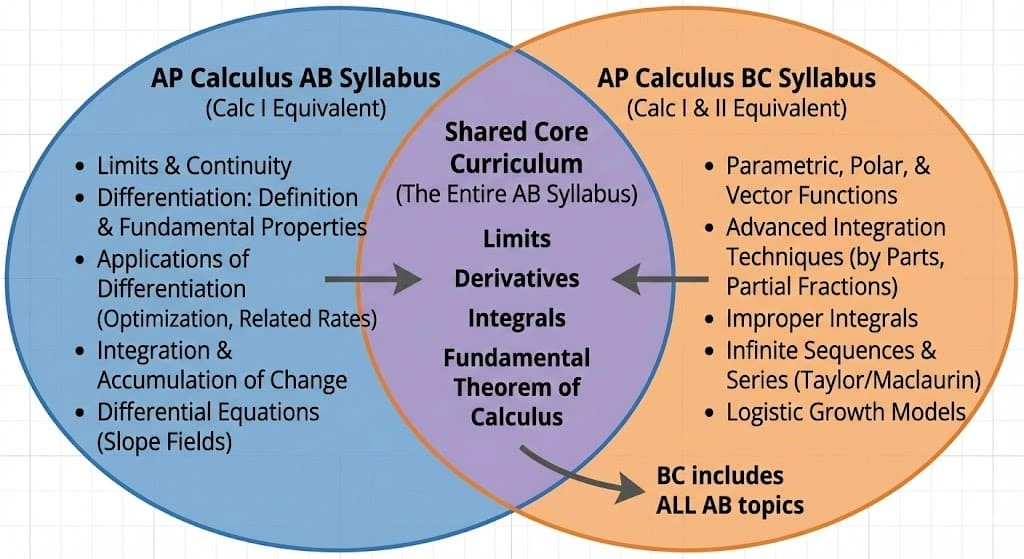
AP Calculus AB vs. BC
Students must choose between two distinct exam paths, though both test a profound understanding of limits, derivatives, and integrals:
- Calculus AB: Covers the equivalent of a first-semester college calculus course. Key topics include differential calculus (finding slopes of tangent lines), basic integral calculus (finding the area under curves), and the Fundamental Theorem of Calculus.
- Calculus BC: Covers a full academic year of college calculus. It includes every single topic tested in AB, plus advanced integration techniques (integration by parts, partial fractions), parametric equations, polar coordinates, and highly complex Taylor and Maclaurin infinite series.
The Free-Response Questions (FRQs)
Half of your AP score is determined by the Free-Response section. Unlike multiple-choice questions, FRQs require you to clearly communicate your mathematical reasoning and justify your answers using correct notation. Whether you are applying the Mean Value Theorem or optimizing a volume using the First Derivative Test, you must write out every logical step. You can use our comprehensive solver tool above to practice and verify the accuracy of your intermediate steps.