Preparing for GCSE Maths
The General Certificate of Secondary Education (GCSE) in Mathematics is a crucial qualification in the UK education system. Whether you are studying under the AQA, Edexcel, or OCR exam boards, securing a strong passing grade (typically a Grade 4 or 5) is essential for progression into A-Levels, apprenticeships, and university admissions.
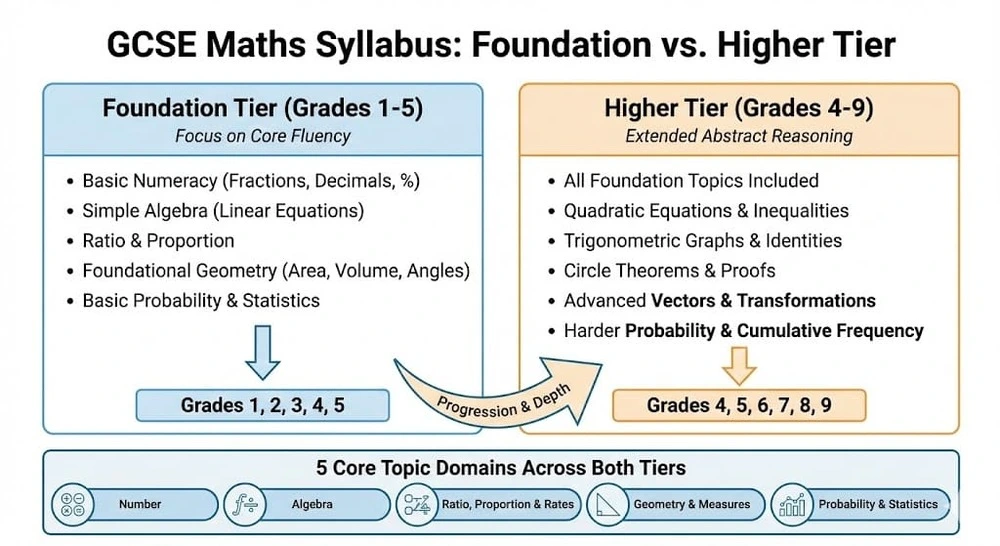
Foundation vs. Higher Tier
GCSE Maths is uniquely tiered to cater to different mathematical abilities. Your school will enter you into one of two tiers:
- Foundation Tier: Covers grades 1 to 5. It focuses heavily on fundamental numeracy, basic algebra (like solving single-step linear equations), ratio, proportion, and foundational geometry.
- Higher Tier: Covers grades 4 to 9. It includes all Foundation topics but introduces highly complex concepts such as quadratic inequalities, trigonometric graphs, circle theorems, and advanced vectors.
Core Subject Areas
Regardless of your exam board, the GCSE Maths syllabus is strictly categorized into five main topic domains:
- Number: Fractions, decimals, percentages, and standard form.
- Algebra: Solving equations, manipulating expressions, sequences, and interpreting graphs.
- Ratio, Proportion & Rates of Change: Direct and inverse proportion, compound measures like speed and density.
- Geometry & Measures: Area, volume, Pythagoras, trigonometry, and transformations.
- Probability & Statistics: Tree diagrams, Venn diagrams, averages, and data representation.
Frequently Asked Questions
Are calculators allowed in all GCSE Maths papers? +
No. Typically, the GCSE Maths assessment consists of three distinct papers. Paper 1 is strictly non-calculator, meaning you must demonstrate manual arithmetic fluency. Papers 2 and 3 usually allow the use of a scientific calculator.
What is considered a "good pass" in the new 9-1 grading system? +
Under the 9-1 system, a Grade 4 is considered a "standard pass" (equivalent to the old Grade C). However, many sixth forms, colleges, and universities consider a Grade 5 to be a "strong pass" and may require it for further academic study.
How can I quickly improve my algebra score? +
Algebra relies heavily on strict procedural rules. The best way to improve is to practice "collecting like terms" and understanding how to isolate a variable using inverse operations. Use our calculator above to verify your step-by-step working during revision.