Mastering the SAT Math Section
The SAT Math section is designed to test your fluency in essential mathematical concepts that are fundamental for college readiness and career success. Unlike traditional memorization exams, the SAT heavily emphasizes problem-solving, mathematical modeling, and strategically applying algebraic concepts to real-world scenarios. The test is officially divided into three primary domains of mathematics.
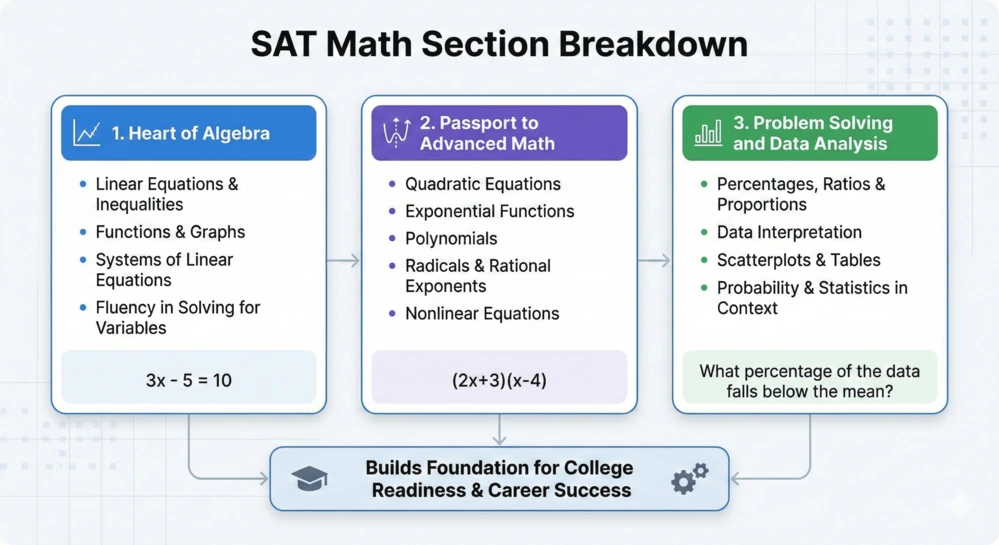
1. Heart of Algebra
This section constitutes roughly a third of the math test. It focuses exclusively on linear equations, linear inequalities, and functions. You must be able to fluently solve for variables (e.g., \( 3x - 5 = 10 \)), create linear equations from word problems, and understand how graphs relate to algebraic equations. Mastery of slope (\( y = mx + b \)) and y-intercepts is non-negotiable.
2. Passport to Advanced Math
This domain tests your readiness for higher-level calculus and statistics. It involves nonlinear equations, specifically quadratic and exponential functions. You will be expected to factor polynomials, utilize the quadratic formula, rewrite complex expressions, and manipulate radicals and rational exponents seamlessly.
3. Problem Solving and Data Analysis
This area focuses entirely on quantitative literacy. Questions here ask you to calculate percentages, analyze ratios and proportions, and interpret complex data presented in scatterplots, bar graphs, and two-way tables. It heavily tests your ability to synthesize statistics and probability in real-world contexts.